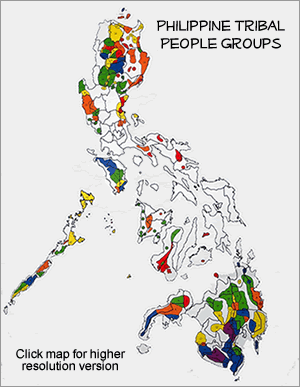

The Eastern Bontoc are an indigenous Igorot people of the central Cordillera mountains in northern Luzon, Philippines. Their communities are centered in the municipality of Barlig in Mountain Province, primarily in the barangays of Barlig, Kadaklan, and Lias. They are also known as the Kadaklan Barlig Bontoc or Eastern/Southern Bontoc. Their language, Bontok, Eastern, is an Austronesian language within the Northern Luzon Cordilleran family, closely related to but distinct from the dialects spoken in Bontoc town and other Igorot communities. Many Eastern Bontoc also speak Ilocano and English.
The Eastern Bontoc, like their Igorot neighbors, have inhabited the steep mountain terrain of the Cordillera for millennia. Their most celebrated cultural achievement is the construction and maintenance of ancient rice terraces — systems of stone-walled paddies carved into nearly vertical mountainsides, irrigated by intricate channels drawing from mountain streams. These terraces, which predate Spanish contact, are among the engineering marvels of the pre-colonial Philippines. Spanish colonial forces repeatedly attempted to subjugate the Cordillera peoples but met sustained and successful resistance; the Eastern Bontoc and their neighbors maintained their independence and cultural integrity throughout the colonial era. American administrators arrived after 1898, and the establishment of Mountain Province brought formal government presence, schools, and eventually Christian missionaries into the region. Population loss through outmigration has been significant in recent decades, as limited land and economic opportunity push young people to seek livelihoods in Baguio, Manila, and abroad.
The daily life of Eastern Bontoc families continues to center on the cultivation of wet rice in terraced paddies, a demanding labor that requires the constant maintenance of stone walls, irrigation canals, and field preparation by hand. Rice is the primary staple crop, supplemented by sweet potato, corn, beans, and millet during leaner months. Families also cultivate home gardens of vegetables, raise pigs and chickens — primarily reserved for ceremonial feasts — and supplement their diet by gathering edible plants and fishing in mountain streams. There is little surplus production, and most families are subsistence farmers. Those needing goods beyond what home gardens and forests provide travel to Bontoc town or as far as Baguio City.
Extended family networks, organized around kinship ties traced through both parents, provide social cohesion and mutual aid during planting, building, and crisis. Elders remain the keepers of oral tradition, ceremonial knowledge, and community authority. The ato — the traditional community ward — continues to function as a center of social organization and ritual life, though its role has evolved under modern governance. Communal celebrations and agricultural rituals mark the high points of the community calendar, particularly the can-ao, a ceremonial feast involving gong music, chanting, animal sacrifice, and the sharing of food among community members, held at significant moments such as marriages, harvests, and blessings for prosperity. Weaving, woodcarving, and the playing of traditional instruments such as the gangsa (bronze gong) and kalaleng (nose flute) remain practiced arts. The complete Bible was translated into Bontok, Eastern and published in 2022, placing the full witness of God's Word in the heart language of this community for the first time.
Indigenous animism is the dominant spiritual framework among the Eastern Bontoc, holding the allegiance of most of the community. The traditional worldview centers on a hierarchy of spiritual beings, including Lumawig — a creator figure and cultural hero who descended from the sky and taught the Bontoc their skills of agriculture and community life — and the anito, spirits of deceased ancestors who are regarded as present and active in daily affairs. The anito must be regularly consulted and appeased through ritual prayer, food offerings, and sacrifice to maintain health, agricultural success, and communal harmony. Disease is understood as spiritual disruption requiring the intervention of ritual specialists. The can-ao feast and the begnas thanksgiving ceremony are not merely social events but sacred encounters with the spiritual world.
A minority of Eastern Bontoc have embraced Christianity, including evangelical faith, and the 2022 completion of the complete Bible in Eastern Bontok has opened a new chapter for the gospel's advance in this community. For those who have heard and received it, the message of Jesus Christ offers deliverance from the cycle of fear and appeasement that drives traditional religious life.
Geographic isolation in the Cordillera mountains limits the Eastern Bontoc's access to healthcare, secondary and tertiary education, and economic opportunity beyond subsistence farming. The outmigration of working-age adults, drawn by the lack of viable employment in Barlig, has created an aging village population and interrupted the intergenerational transmission of language, culture, and agricultural knowledge. Roads into Barlig are difficult and sometimes impassable, making emergency medical care and reliable commerce a challenge.
Spiritually, the great majority of the Eastern Bontoc have not yet encountered the good news of Jesus Christ in a personally meaningful way, and the community of Christian believers, while present, is a small minority. The newly completed Bible in Eastern Bontok is a precious tool awaiting distribution and use, but trained workers who can teach, disciple, and pastor within Eastern Bontoc communities are urgently needed.
Pray that the Eastern Bontoc will encounter the living Christ through the newly completed Bontok, Eastern Bible, and that the Holy Spirit will use God's Word to call many from fear of the spirit world to faith in the Lord Jesus.
Pray for Eastern Bontoc believers to be strengthened in their faith, and for God to raise up local church leaders who will disciple their own people and carry the gospel to other Igorot communities and beyond.
Pray for improved road access, healthcare, and educational opportunities in Barlig and surrounding communities, and that young people will find a future and a hope without being forced to leave their homeland.
Pray for the widespread distribution and engaged reading of the Bontok, Eastern Bible, and for missionaries and Filipino partners who will come alongside Eastern Bontoc believers for the long work of building a maturing, witnessing church.
Scripture Prayers for the Bontoc, Eastern in Philippines.
https://en.wikipedia.org/wiki/Bontoc_people
https://ncca.gov.ph/about-culture-and-arts/culture-profile/glimpses-peoples-of-the-philippines/bontoc/
https://www.yodisphere.com/2022/07/Bontok-Tribe-Culture-Bontoc-People.html
https://www.yodisphere.com/2022/08/Ifiallig-Tribe-Barlig-Mountain-Province.html
https://www.bahayugnayan.org/community-groups/bontoc
https://grokipedia.com/page/Bontoc_people
https://www.jesusfilm.org/watch/jesus.html/finallig.html
https://live.bible.is/bible/EBKFSS
https://ebible.org/find/details.php-id=ebk
| Profile Source: Joshua Project |